
Have you seen a film, where the actor is sitting on a couch, the camera is behind him, and he puts a cigarette to his lips, puffs, and expels the smoke, then the camera focuses on his hand and blurs
the background scene? It presents the world to you as it is from the actor’s perspective. You are seeing the world from the visual perspective of the actor. This technique in filmmaking was taken to an extreme in some arty movies in the 30’s, where you never see the actor to whom the action is happening to at all. In these films, you hear and see only what the actor hears and sees. In effect, you become the actor/actress. These films never caught on and were abandoned by the early 40’s. We, the viewers, want to know what is happening to the actors of a film, not be the person experiencing a scene in a film. These cinematic experiments failed because we watch films to see into the world of others as if they were in a separate dimension, we’re observing but not part of directly. We are not usually conscious of this underlying mental perspective. It is called suspension of disbelief in filmmaking. This aversion to watching a film in first person perspective may change if future developments (like the Wii device in gaming) will let us interact with a movie.
Everyday life is a visual perspective movie to me. I see everything, minus the milliseconds of my blinking eyes, from my head. It feels to me like I see all things in my visual perspective, though I never see the back of my head, nor do I have an idea of my posterior, or back (unless I look at these body parts in a mirror). I am aware of my own body, by a sense of feeling called touch. I can feel my chin, as I am now doing.I feel as if I am looking at an external world through my eyes in a persistent sensation. My looking out at the world through my eyes is never disrupted, choppy, and uncoordinated. The world comes to me through my eyes as a continuous experience. I see all things from my 3Di perspective. I am a being that looks out on his three-dimensional world, with his eyes. By the way, you are too. I never experienced anything, that is 2D. If I pick up a piece of paper that is vertical and horizontal, it still has just the slightest breadth to it too. The paper is thin but still has some depth to it. But, still we as 3D beings do peer in on a 2D world. I’m staring at a computer monitor. The words on this page are what a topologist would call an embedded dimension. That is, the 2D words on the monitor are inside my 3D world. Well, if that’s true, then what about my 3D world? Is it embedded in a larger 4D world? Topologically there is nothing to say it’s not. What is fascinating about this idea is this: We can’t transcend dimensions I can’t touch or get into the words I’m writing now on this 2D screen.So, are there 4D beings beyond us that can’t get into our worlds? If there are, what are they like? Would we be able to communicate with them if they exist across dimensional barriers?
A 4D world is one step higher than our 3D world. First let’s examine the geometry that leads to our 3D worldii. So, look at the graphic below.
 3 dimensional Diagram
The 3 axes x, y, and z give us all the dimensions we need for our 3D world. Now, if we wanted to create a 4D world, then a new axis called w would have to be introduced. For obvious reasons, I can’t show you this 4th axis in a 2-dimensional graphic like above. But, I can show you how it must be generated in a 3D model. Notice that all of the 3 axes in the graphic above meet at 0.Each axis is at a 90 degree angle to the others. If our new dimension called w is to be successfully introduced to this axis system, it too will have to be at a 90-degree angle to the other 3. Let’s set up some fundamental geometric concepts and then see if life forms could exist in these geometries.iii
Points, Lines, Planes and Hyperplanes
In geometry we speak of dimensions or more rarely dimensia to mean classes of space. We can have 1,2,3..N dimensions. This means space itself can have infinitely many dimensions. There is an atomic unit called a point, which comprises all other objects in dimensions. A point is an assumed object that is not defined. A point has no dimensions–no length, width, or depth.Lines are made from at least 2 points. The 2 points must lie on line for the line to be drawn.T his property is called collinearity.Lines unlike points do have a dimension. They have 1 dimension and this dimension can be extended infinitely. Planes are made when a line of 2 collinear points is extended to a third non-collinear point on another line. The plane will consist of at least 4 pairs of collinear points and will extend infinitely in 2
dimensions: length and height. And lastly a hyperplane is made when one plane with 4 collinear pairs is extended to a 5th non-collinear point of another plane.This construction will have 3 dimensions: length, height and width. As an example of a plane and a hyperplane, look at the two graphics below. Points A, B, C and D represent collinear points on 2 lines AB and CD

This plane has both length and height. It extends infinitely in both directions. Below is an example of a hyperplane in 3 dimensions.

Planes ABCD and CDEF intersect along line CD. These two planes together form a hyperplane in 3 dimensions. This hyperplane has length, height and width.
Lastly, a 4-dimensional plane can be formed from 6 points of a hyperplane (in the above case ABCDEF) and some point not in the dimensions they form (i.e. 3 dimensions).As stated above, I cannot draw a graphic of this figure in a 2 or 3-D space.
I’ve given a simple intuitive description of the geometry of dimensions. The same idea can be expressed in algebraic form. Although it’s not necessary to understand multiple dimensions in an algebraic set theory sense, this model will have some bearing later when I discuss connected geometries. Thus, I must include it.
In algebraic set theory the points I defined above are really ordered pairs, such as (a,b). These ordered pairs are members of sets. The first member of an order pair is one dimension (x-axis) and the second member is the next dimension (y-axis). Say we have a collection of ordered pairs called set X (a,b).Take another collection of ordered pairs (c,d) called set Y. Sets X and Y can be related so that they form, lines, planes and hyperplanes. To see this, lets describe the hyperplane ABCDEF named above with algebraic set theory.
Let the points in ABCD name a set X Let the points in CDEF name a set Y.
The symbol means such that │means where, є means member of and, means operated upon or related to. We can now describe the graphics above in algebraic set theory notation:
The line CD on hyperplane ABCDEF is a subset of any ordered pair CD X ∩ Y, that is, CD is the intersection of sets X and Y. The entire hyperplane is defined as follows: the hyperplane ABCDEF is merely the Cartesian product of all order pairs in ABCDEF. A Cartesian product is defined as follows: X oY = {(x,y)│ x є X and y є Y}. A Cartesian product uniquely maps every ordered pair in X to an ordered pair in Y, Thus, ABCDEF hyperplane is the Cartesian product of X o Y and this amounts to being the union of sets X and Y.
Living Beings in Dimensional Spaces
Now that we have a framework of what 2, 3, and 4D spaces are, we can ask certain questions about living beings in these dimensions and their perceptions.I should be more precise. I can’t tell for sure what living beings in dimensions other than our own, 3D realm would look like, but I can conjecture about what they could be
and likewise conjecture exclusions on what they couldn’t be.
2D, 3D and 4D beings
In the satirical little work Flatland, the author, Edwin A. Abbott, actually gives a good account of how beings in 2D would perceive their world. His account of 2D beings bodies is flawed, though it’s meant to be fictional. But that’s not what we’re going to consider yet. He correctly deduced that a 2D being would be only able to perceive lines of varying lengths. So, a triangle for us in 3D would appear to be a straight line for them. 2D beings (assuming there are such beings) can perceive only 2D objects embedded in a higher dimension, e.g. 3D. Going higher on the dimensional scale, we arrive at us: 3D beings. We seem to be able to perceive our world in full 3D mode. We perceive our world locally as flat, while it is curved. When we walk anywhere on this planet, even if we are climbing hills or mountains, we never perceive the terrestrial curve of the planet. We have to get in an aircraft and fly high off the surface of the planet to see the terrestrial curve. Even at this great height, we are STILL only seeing a curvature, of a 3D object, i.e. Earth. Normally, we only see a uniform nearly flat surface in which we move, drive, swim, etc. In fact, due to our size compared to the size of the planet, we are never conscious of the speed at which the globe is spinning (approximately 1000 miles an hour since the circumference of the planet is 24,000 miles). Moreover, we only perceive objects embedded in a higher dimension as 3D. What? I hear you say? What? Yes, as strange as that sounds, we are seeing 3D objects not 3D space! To illustrate my point in 2D first, let’s take an example straight out of Flatlandiv. Abbott gives a diagram similar to the one below. Figure 1 is the view of an equilateral triangle from a 3D perspective, being flipped down. Figure 2 is a perspective from a 2D perspective.
Flip A Triangle To Horizontal
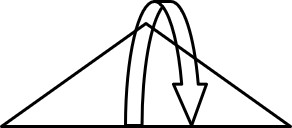
if we move the triangle around in 2D it would not appear any different than a line.

Image of a Line
If we expand this idea to 3D, we perceive all the embedded objects of a 4D dimension as 3D objects. But we can’t see the dimension these objects are embedded in, e.g. the 4D. Physicists refer to the expansion of the universe in spacetime. This universal space-time expansion is our universe expanding into a 4th spatial dimension. This is what we 3D beings can’t see! So, here is the rule, though I will not attempt to prove it mathematically. Beings (if higher or lower dimensional beings exist) in one dimension can perceive only objects embedded in their current dimension or one below it. They never perceive the dimension itself.
TO BE CONTINUED
Robleh Wais 4/13/09
i I will use the abbreviations 1D, 2D, 3D and 4D to mean respectively 1, 2, 3 or 4 dimensions. ii In common parlance, we speak of higher and lower, when referring to abstract concepts that have nothing to do with these geometric terms. I will use these terms throughout this article to conform to popular usage that has made them readily understandable. However, it should be noted that for instance, the 4th dimension is not higher than the 3rd.A more precise term might be outside or the adjective outer, but again these terms are not in common English usage when referring to the idea of dimension.
iii A satirical book called Flatland by Edwin Abbott explores the idea of 2D beings embedded in a 3D world. I recommend it to anyone reading this article.Though much of the geometry it describes might contradict what modern mathematicians would accept, it aptly portraits the idea of living beings in another dimension.
iv Flatland, page 48